

JAMB Government Syllabus 2026: Your Complete Guide to Success
Hello, future university student! Are you getting ready for the Joint Admissions and Matriculation Board (JAMB) exam? If so, you need to know your syllabus very well. The JAMB Government Syllabus 2026 is your map to scoring high in the Government subject. This guide will explain all the topics you must know. We will break down what you should learn and how to study smart. Let’s start your journey to success!
Highlight: This complete guide to the JAMB Government Syllabus 2026 covers all key topics, from basic concepts to Nigeria’s political history and foreign policy, giving you the tools to excel in your UTME exam.
Overview of the JAMB Government Syllabus 2026
First, it’s important to know the goal of this syllabus. The aim is to test your knowledge of Government. This helps decide if you are ready for higher education in Nigeria. You will learn about different systems of government, how Nigeria developed politically, and its role in the world. The table below gives you a quick look at all the main parts of the syllabus.
| Part | Topic Area | Main Focus |
|---|---|---|
| Part I | Elements of Government | Basic ideas, forms of government, arms of government, constitutions, citizenship, and elections. |
| Part II | Political Development in Nigeria | Nigeria’s history from pre-colonial times to today, including constitutions, federalism, and military rule. |
| Part III | Foreign Policy & International Community | Nigeria’s relationships with other countries and its role in global organizations. |
| Part IV | International Organizations | A detailed look at groups like the UN, AU, ECOWAS, and OPEC. |
Now, let’s explore each part of the JAMB Government Syllabus 2026 in more detail.
Topics in JAMB Government Syllabus 2026
Part I: Elements of Government
This first part teaches you the basic building blocks of government and politics.
1. Basic Concepts in Government
You will start by learning important words. These include Power, Authority, Legitimacy, and Sovereignty. Furthermore, you need to know the difference between a Society, a State, a Nation, and a Nation-State. Also, you will study Political Processes. This includes how people learn about politics (Political Socialization), how they get involved (Political Participation), and the shared beliefs about politics in a society (Political Culture).
2. Forms of Government
Next, you will explore different ways a country can be ruled. For example, a Monarchy has a king or queen. An Aristocracy is rule by nobles. An Oligarchy is rule by a few people. Autocracy is rule by one person with total power. Republicanism is a system without a monarch. Finally, Democracy is rule by the people. You must know the definitions, features, merits (good points), and demerits (bad points) of each form.
3. Arms of Government
In most countries, the government is split into three arms to share power.
- The Legislature: This is the law-making body. You will learn about its types (like unicameral or bicameral), structure, functions, and powers.
- The Executive: This arm carries out the laws. You will study its types, functions, and powers.
- The Judiciary: This arm interprets the laws and settles disputes. You will learn about its functions, powers, and components like judges and courts.
Importantly, you must understand how these three arms work together and check each other’s power.
4. Structures of Governance
Countries organize their power in different ways.
- Unitary System: All major power is held by the central government.
- Federal System: Power is shared between a central government and state governments (like in Nigeria).
- Confederal System: Independent states come together and give limited power to a central body.
You must compare their features, reasons for adoption, and their good and bad points.
5. Systems of Governance
This is about how the executive branch is set up.
- Presidential System: The President is both head of state and head of government (like in Nigeria and the USA).
- Parliamentary System: The head of government (Prime Minister) comes from the parliament (like in the UK).
- Monarchical System: A king or queen is the head of state.
6. Political Ideologies
Ideologies are sets of beliefs about how society and the economy should work. You will study:
- Communalism, Feudalism, Capitalism, Socialism, Communism, Totalitarianism, Fascism, and Nazism.
You need to differentiate between them and contrast their economic modes of production.
7. Constitution
A constitution is the supreme law of a country. You will learn its meaning, sources (where it comes from), and functions. Also, you must compare different types: Written vs. Unwritten, and Rigid (hard to change) vs. Flexible (easier to change).
8. Principles of Democratic Government
These are the rules that make a government democratic. They include:
- Ethics and Accountability in public office.
- Separation of Powers between the three arms.
- Checks and Balances so one arm doesn’t become too powerful.
- Rule of Law (everyone obeys the law).
- Representative Government (people elect leaders).
9. Processes of Legislation
This is about how laws are made. You will analyse the processes for creating different types of laws like Acts, Edicts, Bye-laws, Delegated Legislation, and Decrees.
10. Citizenship
Citizenship is about being a legal member of a country. You will learn:
Related Posts:


- Its meaning and types.
- The rights of a citizen.
- Issues like Dual citizenship, renunciation, and deprivation.
- The duties of citizens (like paying taxes).
- The obligations of the state to its citizens (like providing security).
11. The Electoral Process
This covers how leaders are chosen.
- Suffrage: The right to vote and its evolution.
- Election: Types and what makes an election free and fair.
- Electoral System: Methods like first-past-the-post and proportional representation.
- Electoral Commission: Its functions and problems.
12. Political Parties and Party Systems
A political party is a group that seeks to win elections and govern. You will learn their definition, organization, and functions. Additionally, you must distinguish between different Party Systems, like one-party, two-party, and multi-party systems.
13. Pressure Groups
Pressure groups are organizations that try to influence government policy without seeking election themselves (like trade unions). You will evaluate their functions and see how they are different from political parties.
14. Public Opinion
This is what the general public thinks about an issue. You will study how it is formed, how it is measured (e.g., through polls), its functions, and its limitations.
15. The Civil Service
The civil service is the body of permanent government workers who implement policies. You will analyse its definition, characteristics, functions, structure, how it is controlled, and its problems.
Part II: Political Development in Nigeria
This part focuses on Nigeria’s own political story from the past to the present.
1. Pre-colonial Politics
Before colonial rule, different Nigerian societies had their own systems. You will study the structural organization of groups like the Pre-jihad Hausa, Emirate, Tiv, Igbo, and Yoruba. Also, you will learn the functions of their political institutions.
2. Imperialist Penetration
This is about how the British and French came to rule Nigeria.
- You will trace the British process: trade, missionary work, company rule, crown colony, and protectorate.
- You will learn about British colonial policy (Direct and Indirect Rule) and French policy (Assimilation and Association).
- Finally, assess the impact of colonial rule and compare British and French methods.
3. Process of Decolonization
This covers how Nigeria fought for and gained independence.
- Nationalism: Its meaning, types, and the movements that emerged.
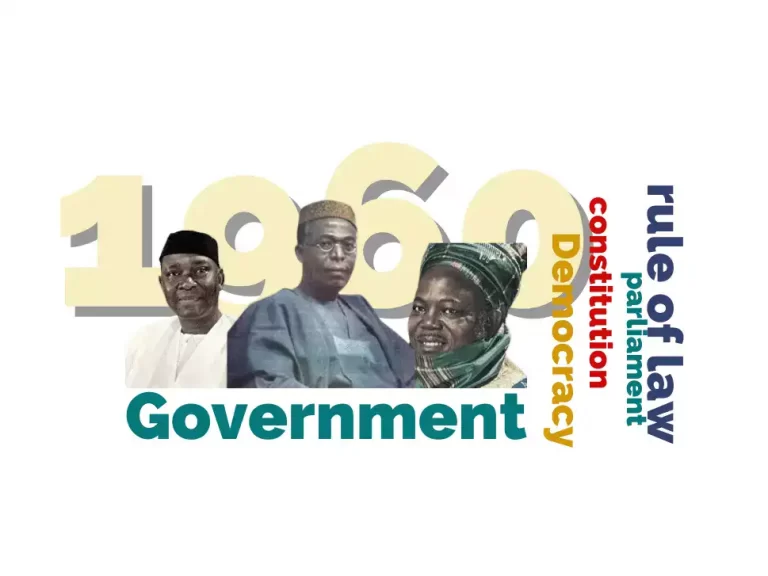
- Nationalist Leaders: Key figures like Herbert Macaulay, Nnamdi Azikiwe, Obafemi Awolowo, and Ahmadu Bello.
- The role of nationalist parties and external factors like World War II.
4. Constitutional Development in Nigeria (Colonial Era)
You will compare the early constitutions that shaped Nigeria:
- Clifford Constitution (1922)
- Richards Constitution (1946)
- Macpherson Constitution (1951)
- Lyttleton Constitution (1954)
- Independence Constitution (1960)
Know their features, merits, and demerits.
5. Post-Independence Constitutions
After 1960, Nigeria created new constitutions. You need to assess the workings and shortcomings of the 1963, 1979, 1989, and 1999 constitutions.
6. Institutions of Government in Post-Independence Nigeria
Look at how the three arms of government (Legislature, Executive, Judiciary) have worked in Nigeria since independence. Evaluate their structure, functions, and operations.
7. Public Commissions
These are bodies set up by the constitution for specific tasks. You will evaluate the objectives, functions, and problems of commissions like the Civil Service Commission, Public Complaints Commission, and Electoral Commissions.
8. Political Parties and Party Politics
Examine how party politics worked in Nigeria’s different republics:
- First Republic
- Second Republic
- Third Republic
- Fourth Republic
You should contrast their processes and evaluate the parties’ ideologies and structures.
9. The Structure and Workings of Nigerian Federalism
Nigeria uses a federal system. You will:
- Examine the rationale (reasons) for it.
- Understand the relationship between the three tiers: Federal, State, and Local.
- Trace the creation of states in 1963, 1967, 1976, 1987, 1991, and 1996.
- Identify problems like census disputes and revenue allocation, and solutions like the Federal Character principle.
10. Public Corporations and Parastatals
These are government-owned businesses (like NNPC). Learn their definition, types, and functions. Also, study the processes of Deregulation, Privatization, and Commercialization, including their merits and demerits.
11. Local Government
Local government is the government closest to the people. You will:
- Trace its administration before 1976.
- Know the features of the 1976 and 1989 reforms.
- Understand the role of traditional rulers.
- Identify its major problems in Nigeria.
12. The Military in Nigerian Politics
The military ruled Nigeria for many years. You will:
- Evaluate the reasons for military intervention.
- Assess the impact of military rule (both political and economic).
- Determine the processes that led to military disengagement (handing back to civilians).
Part III: Foreign Policy and Nigeria’s Relationship with the International Community
This part is about how Nigeria interacts with the rest of the world.
1. Foreign Policy
Learn the definition, purpose, and factors that determine a country’s foreign policy. Also, understand how it is formulated and implemented.
2. Nigeria’s Foreign Policy
Identify the major objectives of Nigeria’s foreign policy. Analyse its relations with major powers (like the USA and UK) and with developing countries. Furthermore, understand Nigeria’s Non-Alignment Policy (not permanently siding with any major power bloc).
3. Nigeria’s Relations with African Countries
Africa is the “centre piece” of Nigeria’s foreign policy. Evaluate Nigeria’s role in continental affairs and its guiding principles. Also, assess the role of NEPAD (New Partnership for Africa’s Development).
4. Nigeria in International Organizations
Analyze Nigeria’s involvement in key global groups:
- The United Nations (UN)
- The Commonwealth
- The Organization of African Unity (OAU) / African Union (AU)
- The Economic Community of West African States (ECOWAS)
- The Organization of Petroleum Exporting Countries (OPEC)
Assess Nigeria’s contribution to these groups and how they help Nigeria’s development.
Part IV: International Organizations
This section looks deeper into major international bodies. You will evaluate the origin, objectives, structure, functions, achievements, problems, and prospects of:
- ECOWAS
- OAU/AU
- Commonwealth
- OPEC
- UNO
- African Petroleum Producers Association
Recommended Textbooks for JAMB Government Syllabus 2026
To study well, use these recommended books:
- Adigwe, F – Essentials of Government for West Africa
- Anifowose, R and Enemuo, F. C. – Elements of Politics
- Appadorai, A. – The Substance of Politics
- Ball, A. R. – Modern Politics and Government
- Ofoegbu, R. – Government for the Certificate Year
- Olawale, J. B – New Topics on Ordinary Level Government
- Oyediran, O. et al – Government for Senior Secondary Schools, Books 1, 2 and 3
- Oyeneye, I. et al – Round-Up Government for Senior Secondary School Certificate Examination
- Oyovbaire, S. et al – Countdown to Senior Secondary Certificate Examination: Government
How to Study Using the JAMB Government Syllabus 2026
- Use it as a Checklist: Go through each topic in all four parts. Tick them off as you study them.
- Focus on the Objectives: For each topic, look at the “Candidates should be able to” list. These are the exact skills JAMB will test. Make sure you can do each one.
- Connect History to Concepts: Link the ideas in Part I (like federalism, constitutions) to the Nigerian examples in Part II. This helps you understand better.
- Make Notes and Timelines: For Nigerian political development, create a timeline of key events (constitutions, military coups). It makes memorization easier.
- Practice with Past Questions: After studying a section, answer past JAMB questions on it. This shows you the exam format and helps you practice.
Conclusion
In conclusion, the JAMB Government Syllabus 2026 is your key to success. By mastering all the elements of government, Nigeria’s political history, and its global relations, you build strong knowledge. Remember to study regularly, use good textbooks, and practice past questions. Good luck with your preparation! You are now ready to tackle the Government section of the UTME with confidence.
You may need to check these other syllabuses that we have created for you:
Mathematics Syllabus
Economics Syllabus
Commerce Syllabus
Financial Accounting Syllabus
Literature in English Syllabus