



Introduction
Economics as a science is the study of how people and societies make choices about using limited resources to satisfy unlimited wants. This field of study helps us understand how individuals, businesses, and governments make decisions when resources are scarce. Economics as a science uses scientific methods to analyze human behavior and predict outcomes in various economic situations.
Learning Objectives
After studying this topic, students should be able to:
- Compare various concepts in economics and their applications
- Interpret graphs and schedules in relation to economic concepts
- Identify economic problems in different situations
- Proffer solutions to economic problems using economic principles
- Apply the Production Possibility Frontier (PPF) to solve economic problems
Basic Economic Concepts
1. Wants
Wants refer to human desires for goods and services that provide satisfaction or utility. These desires are unlimited and constantly changing. For example, a student may want a smartphone, fashionable clothes, good food, and quality education. Moreover, once one want is satisfied, another emerges. This endless nature of human wants creates the fundamental economic problem.
Human wants can be classified into:
- Primary wants: Basic needs for survival like food, water, shelter, and clothing
- Secondary wants: Comfort items that improve quality of life such as entertainment, luxury goods
- Tertiary wants: Status symbols and prestige items like expensive cars or designer items
2. Scarcity
Scarcity is the basic economic problem that arises because people have unlimited wants but resources are limited. Therefore, not all wants can be satisfied at the same time. For instance, a country may have limited funds and must choose between building more schools or hospitals. This situation forces individuals and societies to make difficult choices.
Scarcity exists because:
- Resources are finite (limited in quantity)
- Human wants are infinite (unlimited)
- Resources have alternative uses
3. Choice
Choice is the act of selecting one option from several alternatives. Since resources are scarce, people must choose which wants to satisfy first. Furthermore, every choice involves giving up something else. When a student chooses to spend money on books instead of entertainment, they have made an economic choice.
The need for choice arises from:
- Limited resources
- Unlimited wants
- Alternative uses of resources
4. Scale of Preference
Scale of preference is a list that shows the order of priority in which an individual ranks their wants. It helps people organize their wants from most important to least important. Additionally, this ranking helps in making rational decisions about resource allocation.
For example, a student’s scale of preference might be:
- School fees (most important)
- Textbooks
- Food
- Transportation
- Entertainment (least important)
The scale of preference is important because it:
- Helps in making rational choices
- Guides resource allocation
- Reduces wasteful spending
- Ensures important needs are met first
5. Opportunity Cost
Opportunity cost is the value of the best alternative forgone when making a choice. In other words, it is what you give up to get something else. When a farmer uses land to grow rice instead of yam, the opportunity cost is the yam that could have been produced.
Key features of opportunity cost:
- It involves the next best alternative
- It applies to all economic decisions
- It helps in rational decision-making
- It measures the true cost of any choice
Example: If a government spends ₦100 billion on road construction instead of education, the opportunity cost is the educational facilities and programs that could have been provided with that money.
6. Rationality
Rationality in economics assumes that individuals make logical decisions to maximize their satisfaction or utility. A rational consumer will choose goods that give them the highest satisfaction given their income. Similarly, a rational producer will choose production methods that maximize profits.
Characteristics of rational behavior:
- Consistency in choices
- Maximizing benefits
- Minimizing costs
- Using available information effectively
However, in reality, people may not always act rationally due to:
- Limited information
- Emotional factors
- Habitual behavior
- Social influences
7. Production
Production is the process of combining various inputs (land, labor, capital, and entrepreneurship) to create goods and services that satisfy human wants. It involves transforming raw materials into finished products. For example, a bakery combines flour, sugar, and labor to produce bread.
The production process involves:
- Inputs: Resources used in production (factors of production)
- Process: The transformation activity
- Outputs: The final goods or services produced
Types of production:
- Primary production: Extracting raw materials (farming, mining, fishing)
- Secondary production: Manufacturing and processing (factories, construction)
- Tertiary production: Providing services (banking, education, healthcare)
8. Distribution
Distribution refers to how goods and services are shared among members of society. It also involves how the factors of production (land, labor, capital, entrepreneurship) receive their rewards. Furthermore, distribution determines who gets what, when, and how much.
Types of distribution:
- Functional distribution: How income is shared among factors of production
- Personal distribution: How income is shared among individuals
- Geographical distribution: How goods are shared across different locations
The distribution system affects:
- Income equality
- Standard of living
- Economic growth
- Social stability
9. Consumption
Consumption is the final use of goods and services to satisfy human wants. It is the end goal of all economic activity. When people buy and use products like food, clothes, or entertainment, they are engaging in consumption. Moreover, consumption drives demand, which influences production decisions.
Types of consumption:
- Productive consumption: Using goods to produce other goods (raw materials)
- Final consumption: Direct satisfaction of wants (food, clothing)
- Individual consumption: Personal use of goods and services
- Collective consumption: Community use (public parks, roads)
Factors affecting consumption:
- Income level
- Prices of goods
- Consumer preferences
- Future expectations
Economic Problems
Every society faces three fundamental economic problems due to scarcity. These problems must be solved by any economic system, whether traditional, market, or command economy.
1. What to Produce?
This problem involves deciding which goods and services to produce and in what quantities. Since resources are limited, societies cannot produce everything they want. Therefore, they must choose which goods will best satisfy their needs.
Factors influencing what to produce:
- Consumer demand and preferences
- Available resources and technology
- Government policies and priorities
- Profitability considerations
For example, a country may need to decide whether to allocate more resources to producing agricultural products or manufactured goods. This decision affects the entire economy and people’s welfare.
2. How to Produce?
This problem concerns the methods and techniques of production. Producers must decide which combination of resources (land, labor, capital) to use. Additionally, they must choose appropriate technology and production processes.
Key considerations in how to produce:
- Technology choice: Labor-intensive vs capital-intensive methods
- Resource availability: Abundant vs scarce factors
- Cost effectiveness: Minimizing production costs
- Environmental impact: Sustainable production methods
For instance, a textile company may choose between using many workers (labor-intensive) or modern machines (capital-intensive) to produce clothes.
3. For Whom to Produce?
This problem deals with the distribution of goods and services among members of society. It determines who gets access to the produced goods and services. Furthermore, it affects income distribution and social welfare.
Distribution mechanisms include:
- Market mechanism: Based on purchasing power
- Government allocation: Through public services and welfare
- Traditional methods: Based on customs and social status
- Mixed systems: Combination of market and government allocation
For example, luxury cars may be produced for wealthy individuals, while basic healthcare might be provided for everyone through government programs.
4. Efficiency of Resource Use
Efficiency involves getting the maximum output from available resources or achieving a given output with minimum resources. There are two main types of efficiency:
a) Productive Efficiency: Producing goods at the lowest possible cost using the best available technology and methods.
b) Allocative Efficiency: Producing the right combination of goods that society wants most, given available resources.
Factors promoting efficiency:
- Proper planning and coordination
- Technological advancement
- Skill development and training
- Competitive markets
- Good governance and institutions
Production Possibility Frontier (PPF)
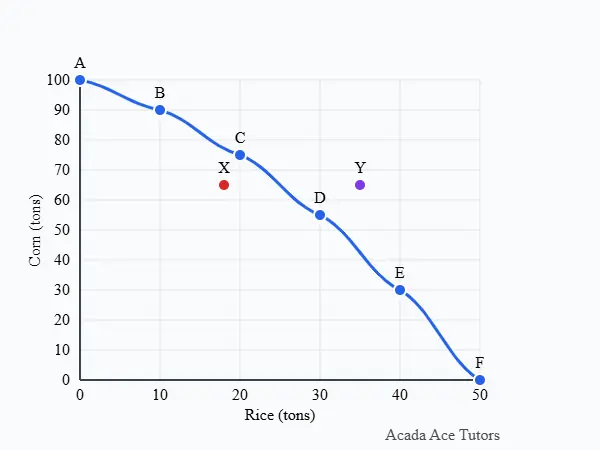
The Production Possibility Frontier (PPF) is a graphical representation that shows the maximum combinations of two goods that an economy can produce using all available resources efficiently. It illustrates several important economic concepts and helps solve economic problems.
Features of PPF
- Downward sloping: To produce more of one good, some production of the other must be sacrificed
- Concave to origin: Due to increasing opportunity cost
- Points on the curve: Represent efficient resource use
- Points inside the curve: Represent inefficient resource use
- Points outside the curve: Are currently unattainable with existing resources
PPF and Economic Problems
1. What to Produce?
The PPF shows all possible combinations of goods that can be produced. Society can choose any point on the curve based on its preferences and needs. For example, a country producing both guns and butter can choose more guns for security or more butter for civilian consumption.
2. How to Produce?
Different production techniques can shift the PPF. More efficient methods will shift the curve outward, showing that more can be produced with the same resources. Technological improvements and better resource allocation enhance production capacity.
3. For Whom to Produce?
While PPF doesn’t directly show distribution, the goods produced (shown by the chosen point on PPF) will be distributed among society members through various mechanisms.
4. Efficiency
- Points on the PPF represent full employment and efficient resource use
- Points inside the PPF show unemployment or inefficiency
- Points outside are currently impossible but may become achievable with more resources or better technology
Economic Growth and PPF
Economic growth is represented by an outward shift of the PPF. This can occur due to:
- Increase in quantity of resources
- Improvement in quality of resources
- Technological advancement
- Better organization and management
Opportunity Cost and PPF
The slope of the PPF represents opportunity cost. As we move along the curve, the opportunity cost of producing one good increases. This is called the law of increasing opportunity cost, which occurs because resources are not perfectly adaptable to all uses.
Applications of Economic Concepts
Resource Allocation in Developing Countries
Developing countries like Nigeria face severe scarcity problems. Limited resources must be allocated among competing needs such as education, healthcare, infrastructure, and defense. The government uses economic principles to make these difficult choices.
For example, when allocating the national budget, the government considers:
- Opportunity cost of each expenditure
- Scale of preference for national priorities
- Efficiency in resource use
- Distribution effects on different groups
Individual Decision Making
Individuals apply economic concepts daily:
- Choice: Selecting between different goods and services
- Opportunity cost: Considering what is given up for each purchase
- Rationality: Making decisions that maximize satisfaction within budget constraints
- Scale of preference: Prioritizing needs and wants
Business Applications
Businesses use economic concepts for:
- Production decisions: Choosing what goods to produce
- Resource allocation: Deciding how to combine inputs efficiently
- Pricing strategies: Understanding consumer behavior and demand
- Investment choices: Evaluating opportunity costs of different projects
Tables and Graphs
Table 1: Scale of Preference Example
| Priority | Want | Reason |
|---|---|---|
| 1 | Food | Basic survival need |
| 2 | Shelter | Protection and security |
| 3 | Education | Long-term development |
| 4 | Transportation | Mobility and access |
| 5 | Entertainment | Recreation and enjoyment |
Table 2: Production Possibilities for Corn and Rice
| Combination | Corn (tons) | Rice (tons) | Opportunity Cost of Rice |
|---|---|---|---|
| A | 100 | 0 | – |
| B | 90 | 10 | 10 tons of corn |
| C | 75 | 20 | 15 tons of corn |
| D | 55 | 30 | 20 tons of corn |
| E | 30 | 40 | 25 tons of corn |
| F | 0 | 50 | 30 tons of corn |
Graph: Production Possibility Frontier
Detailed Analysis of PPF Points
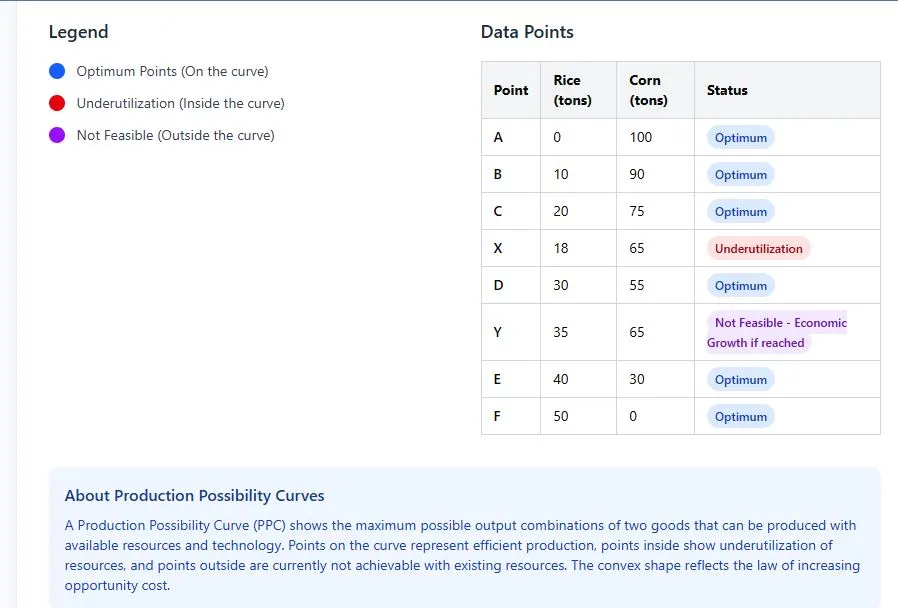
Points A, B, C, D, E, F (On the curve) – OPTIMUM: These points represent maximum efficiency in resource utilization. All available resources are fully employed, and the economy is producing the highest possible combination of both goods. Any point on the PPF curve shows optimal resource allocation.
Point X (Inside the curve) – UNDERUTILIZATION: This point indicates that resources are not being used efficiently. There may be unemployment of labor, idle machinery, or wastage of natural resources. The economy could produce more of both goods without additional resources by moving to the PPF curve. This represents economic inefficiency.
Point Y (Outside the curve) – NOT FEASIBLE: This point is currently impossible to achieve with existing resources and technology. However, it represents potential economic growth. If the economy can increase its resources (more land, labor, capital) or improve technology, the entire PPF curve would shift outward, making point Y achievable.
Key Lessons from PPF Analysis:
- Efficiency: Economy should strive to operate on the PPF curve
- Growth: Moving the curve outward through resource increase or technological advancement
- Choice: Any point on the curve requires trade-offs between the two goods
- Opportunity Cost: Moving along the curve shows what must be sacrificed
Economic Systems and Problem-Solving
Different economic systems solve the fundamental economic problems in various ways:
1. Market Economy (Capitalism)
- What: Determined by consumer demand and market forces
- How: Producers choose methods that maximize profits
- For whom: Based on purchasing power and ability to pay
- Efficiency: Promoted through competition
2. Command Economy (Socialism)
- What: Government decides production priorities
- How: Central planning determines production methods
- For whom: Government allocates goods and services
- Efficiency: May be compromised by lack of market signals
3. Mixed Economy
- What: Combination of market forces and government intervention
- How: Both private and public sectors participate in production
- For whom: Market distribution with government welfare programs
- Efficiency: Balances market efficiency with social equity
4. Traditional Economy
- What: Based on customs and traditions
- How: Traditional methods passed down through generations
- For whom: According to social status and customs
- Efficiency: Often limited by resistance to change
Contemporary Economic Challenges
Modern economies face additional challenges in solving basic economic problems:
1. Environmental Concerns
Economic activities must consider environmental sustainability. The PPF must account for environmental costs, and production decisions should minimize ecological damage.
2. Technological Disruption
Rapid technological changes affect how goods are produced and what skills are needed. This creates new opportunities but also challenges for workers and businesses.
3. Globalization
International trade and investment create new possibilities but also increase competition and economic interdependence.
4. Income Inequality
The “for whom” question becomes more complex as income gaps widen, requiring policy interventions to ensure fair distribution.
Policy Implications
Governments use economic principles to design effective policies:
1. Education Policy
Investment in education increases human capital, shifting the PPF outward and improving long-term economic growth.
2. Healthcare Policy
Healthy populations are more productive, contributing to economic efficiency and growth.
3. Infrastructure Development
Better infrastructure reduces production costs and improves efficiency across the economy.
4. Environmental Regulations
Balancing economic growth with environmental protection ensures sustainable development.
Conclusion
Economics as a science provides essential tools for understanding and solving resource allocation problems. The basic concepts of wants, scarcity, choice, opportunity cost, and rationality form the foundation for analyzing economic behavior. Meanwhile, the Production Possibility Frontier serves as a powerful tool for visualizing trade-offs and efficiency in resource use.
Understanding these concepts helps individuals, businesses, and governments make better decisions in a world of limited resources. Furthermore, the application of economic principles can lead to more efficient resource use, better distribution of goods and services, and improved living standards for society.
As economies continue to evolve, these fundamental concepts remain relevant for addressing new challenges such as technological change, environmental sustainability, and global economic integration. Therefore, mastering these basic economic concepts is crucial for anyone seeking to understand how societies organize their economic activities and solve the eternal problem of scarcity.
Past Questions (UTME Style)
1. The basic economic problem arises because: a) People are greedy b) Resources are unlimited c) Wants are unlimited while resources are limited d) Government policies are poor
2. Opportunity cost is: a) The money spent on a good b) The value of the next best alternative forgone c) The total cost of production d) The market price of a good
3. A point inside the Production Possibility Frontier indicates: a) Efficient resource use b) Maximum production capacity c) Inefficient resource use or unemployment d) Impossible production level
4. The scale of preference helps in: a) Reducing the cost of goods b) Ranking wants in order of importance c) Increasing production capacity d) Eliminating scarcity
5. Which of the following is NOT a factor of production? a) Land b) Labor c) Money d) Capital
6. The three basic economic questions are: a) When, where, and why to produce b) What, how, and for whom to produce c) Who, what, and when to produce d) How much, when, and where to produce
7. Production efficiency means: a) Producing at the lowest possible cost b) Producing the maximum quantity c) Using the most expensive technology d) Employing many workers
8. An outward shift of the PPF indicates: a) Economic decline b) Reduced resources c) Economic growth d) Increased unemployment
9. Rational behavior in economics assumes people: a) Always make mistakes b) Act to maximize their satisfaction c) Ignore costs and benefits d) Make random choices
10. Scarcity exists because: a) People don’t work hard enough b) Resources have alternative uses and are limited c) Technology is backward d) Population is too small
11. The problem of “what to produce” is concerned with: a) Production techniques b) Distribution methods c) Choice of goods and services to produce d) Location of production
12. Which point on the PPF shows the maximum production of both goods? a) Any point on the curve b) Points inside the curve c) Points outside the curve d) None of the above
13. Consumption refers to: a) The production of goods b) The final use of goods and services c) The storage of goods d) The transportation of goods
14. The slope of the PPF represents: a) Total cost b) Fixed cost c) Opportunity cost d) Variable cost
15. In a market economy, the question “for whom to produce” is answered by: a) Government allocation b) Traditional customs c) Purchasing power of consumers d) Random distribution
16. Economic growth can be achieved through: a) Reducing production b) Increasing resources or improving technology c) Decreasing efficiency d) Limiting trade
17. The law of increasing opportunity cost explains why PPF is: a) Straight line b) Concave to the origin c) Convex to the origin d) Vertical line
18. Distribution in economics refers to: a) Transportation of goods b) Sharing of goods and income among people c) Storage of products d) Advertisement of products
19. A command economy solves economic problems through: a) Market forces b) Traditional methods c) Government planning d) Foreign aid
20. Human wants are described as: a) Limited and satisfiable b) Unlimited and insatiable c) Fixed and unchanging d) Decreasing over time
21. A point inside the Production Possibility Frontier represents: a) Maximum efficiency b) Underutilization of resources c) Economic growth d) Perfect resource allocation
22. Points outside the PPF are considered: a) Efficient production points b) Wasteful production points c) Not feasible with current resources d) The best production combinations
23. To move from a point inside the PPF to a point on the PPF requires: a) More resources b) Better technology only c) More efficient use of existing resources d) Reduced production
24. Economic growth is shown on the PPF by: a) Movement along the curve b) Points inside the curve c) An outward shift of the entire curve d) Points on the curve
25. The optimum points on a PPF are: a) Points inside the curve b) Points outside the curve c) Points on the curve only d) The midpoint of the curve
Answer Key: 1-c, 2-b, 3-c, 4-b, 5-c, 6-b, 7-a, 8-c, 9-b, 10-b, 11-c, 12-d, 13-b, 14-c, 15-c, 16-b, 17-b, 18-b, 19-c, 20-b, 21-b, 22-c, 23-c, 24-c, 25-c
References
Lipsey, R. G., & Chrystal, K. A. (2015). Economics (13th ed.). Oxford University Press.
Mankiw, N. G. (2020). Principles of economics (8th ed.). Cengage Learning.
Samuelson, P. A., & Nordhaus, W. D. (2019). Economics (20th ed.). McGraw-Hill Education.
Begg, D., Vernasca, G., Fischer, S., & Dornbusch, R. (2014). Economics (11th ed.). McGraw-Hill Education.
Parkin, M., Powell, M., & Matthews, K. (2012). Economics (8th ed.). Pearson Education Limited.
Sloman, J., Wride, A., & Garratt, D. (2015). Economics (8th ed.). Pearson Education Limited.
Stiglitz, J. E., & Walsh, C. E. (2017). Economics (4th ed.). W. W. Norton & Company.
Case, K. E., Fair, R. C., & Oster, S. M. (2016). Principles of economics (12th ed.). Pearson Education.
Krugman, P., & Wells, R. (2018). Economics (5th ed.). Worth Publishers.
McConnell, C. R., Brue, S. L., & Flynn, S. M. (2018). Economics: Principles, problems, and policies (21st ed.). McGraw-Hill Education.
